The decision of which cloud platform to build your company on is one of the most consequential choices a startup founder will make. It’s a commitment that goes far beyond initial costs, deeply influencing your company’s technical architecture, development speed, and ability to scale in the long run. The two titans in the world of cloud services, Amazon Web Services (AWS) and Microsoft Azure, both offer powerful ecosystems, but they are guided by very different philosophies born from their unique histories. Understanding this strategic landscape is the essential first step for any startup looking to align its technology with its business goals.
Market Dominance and the AI Gold Rush
For years, the cloud infrastructure market has been led by AWS, which pioneered the space in 2006, a full four years before Azure officially launched. This head start allowed AWS to build a mature, feature-rich platform and capture a commanding market share that consistently hovers between 30% and 33%. Microsoft Azure is the clear and aggressive challenger, holding the second-largest share at around 21% to 24%. However, recent trends show a fascinating shift in momentum. While AWS remains the leader, its growth has recently slowed, partly due to challenges in meeting the incredible demand for AI infrastructure. In stark contrast, Microsoft Azure’s growth has accelerated to an impressive 33% year-over-year, largely supercharged by its AI services. This signals that for a startup, the choice of a cloud platform is not just about its current state, but a strategic bet on its future direction, especially if AI is central to your business.
Two Core Philosophies: A Universe of Blocks vs. An Integrated Ecosystem
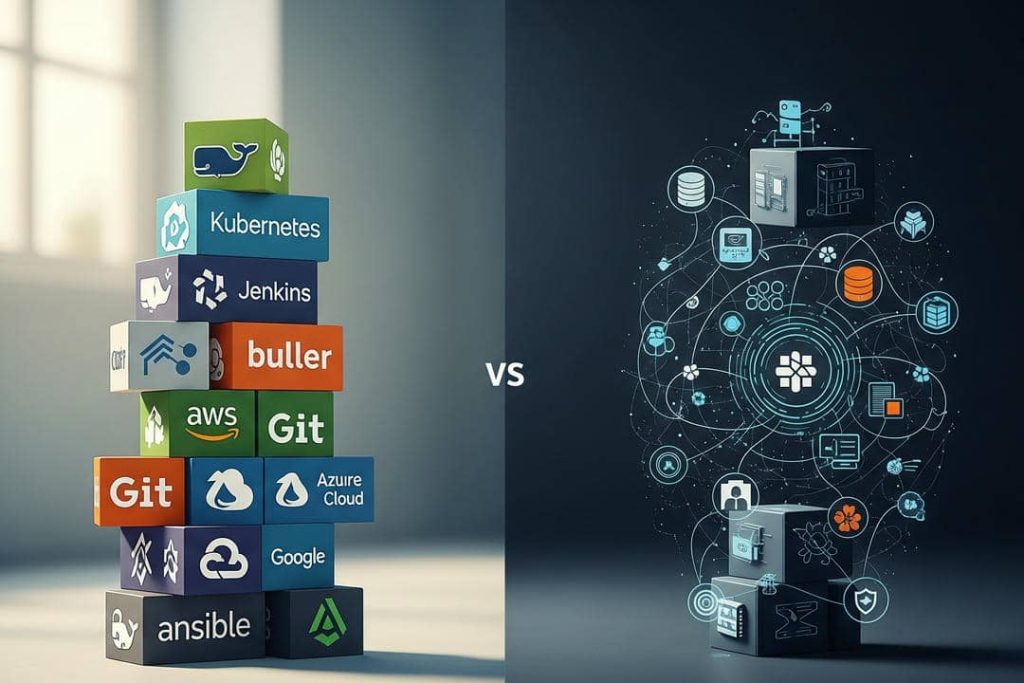
The different growth patterns of AWS and Azure reflect their foundational philosophies. AWS approaches cloud services as a vast, modular “universe” of over 200 discrete services that function like fundamental building blocks. This design is perfect for cloud-native companies that prioritize open-source technology and want the flexibility to build highly customized solutions from the ground up. In contrast, Azure’s core strength is its deep and seamless integration with the sprawling Microsoft enterprise ecosystem. For any organization already using Microsoft technologies like Windows Server, SQL Server, or Office 365, Azure provides a unified and familiar environment, making it the natural choice. This creates a powerful “ecosystem gravity” where the decision is less about a feature-by-feature comparison and more about which platform exerts a stronger pull on your existing technology, team skills, and business model.
The Engine Room: Powering Your Application
Compute services are the engine of any web application, and the choice of virtual machines is a foundational one. AWS Elastic Compute Cloud (EC2) offers an unparalleled breadth of options, with more than double the instance types of Azure, allowing for precise optimization. This includes unique hardware like ARM-based Graviton processors that offer better price-performance for Linux workloads and Mac instances for developing on Apple’s ecosystem.
Azure Virtual Machines offers a more curated but still comprehensive selection. Its standout feature is the deep, economic advantage of its integration with the Microsoft ecosystem. For a startup building on a
.NET and SQL Server stack, programs like the Azure Hybrid Benefit, which allows you to reuse existing licenses, can make Azure VMs significantly cheaper than running the same workload on AWS. This creates a clear trade-off: EC2’s breadth versus Azure’s integrated depth.
The Modern Approach: Serverless Computing
Serverless computing allows developers to run code without managing servers, a model ideal for scalable and cost-effective applications. Here we see a trade-off between maturity and modernization.
AWS Lambda, the service that defined the market, is mature and battle-tested, generally considered to have a performance edge in minimizing “cold start” latency. Azure Functions takes a more flexible and modern approach by offering multiple hosting models, allowing startups to choose between a true pay-per-use plan or a “pre-warmed” premium plan that eliminates cold starts entirely.
Perhaps its most unique feature is Durable Functions, an extension that enables the creation of complex, long-running serverless workflows directly in code, a task that would require a separate service on AWS.

Your Data’s Home: Storage and Databases
For storing files like images and videos, both AWS S3 and Azure Blob Storage are massively scalable and durable. The choice between them is rarely driven by minor feature differences but rather by “ecosystem alignment”. An application built on other AWS services will find S3 to be the frictionless choice, while a startup using Azure Active Directory for identity will find Blob Storage far more intuitive to manage. For relational databases, the philosophies diverge sharply. AWS RDS for SQL Server offers a server-oriented experience, giving you control over a specific version of SQL Server, which is ideal for migrating legacy applications. Azure SQL Database is a true service-oriented platform that abstracts the server away and always runs on the latest version, simplifying management but reducing version control.
The Intelligence Layer: The AI and Machine Learning Arms Race
AI has become a critical battleground for cloud services. For building custom models, the choice is between the expert’s choice and the user-friendly path. Amazon SageMaker is a comprehensive platform favored by experienced data scientists for its power and granular control, though it has a steeper learning curve.
Azure Machine Learning, with its visual drag-and-drop studio, focuses on democratizing AI, making it highly accessible to non-experts. In the generative AI arms race, they also have different strategies.
Amazon Bedrock acts as a versatile marketplace, offering access to leading models from various companies like Anthropic, Meta, and Cohere through a single API. Microsoft has pursued a deep partnership with OpenAI, and its Azure OpenAI Service provides exclusive, enterprise-grade access to the powerful and well-known GPT-4 models. This presents a choice between Bedrock’s flexibility and Azure’s focused access to a best-in-class partner.
The Bottom Line: Pricing and Founder-Friendly Programs
For any startup, cash flow is king. Both platforms offer standard pay-as-you-go pricing, along with commitment-based Reserved Instances that can save over 70% for predictable workloads. Both also offer access to spare compute capacity via “Spot” instances at up to a 90% discount. However, the single most significant pricing differentiator is the Azure Hybrid Benefit. This program allows companies with existing Windows Server and SQL Server licenses to reuse them on Azure, with some analyses showing that running Windows workloads can be up to 5 times more expensive on AWS as a result.
For early-stage startups, free credits are a lifeline. AWS Activate offers up to $100,000 in credits, though the top tier typically requires an affiliation with a VC or accelerator. Microsoft for Startups Founders Hub is tiered and can offer up to $150,000 in credits, along with free access to valuable tools like GitHub Enterprise and OpenAI models. These programs are designed to create long-term platform loyalty, so this early choice can define your company’s technology stack for years to come.
The Final Verdict: Making the Right Choice for Your Startup
The decision between AWS and Azure is not about which platform is universally better, but which is strategically aligned with your startup’s unique DNA. The choice is often driven by two powerful gravitational forces: ecosystem familiarity and the availability of startup credits.
A startup should strongly lean towards AWS if it is focused on open-source technologies, requires maximum flexibility from a vast catalog of services, or needs specialized hardware like Graviton processors or Mac instances. It’s also the superior choice if your AI strategy depends on having the flexibility to experiment with models from many different providers via Amazon Bedrock.
A startup will find a more frictionless path on Azure if it is deeply invested in the Microsoft ecosystem (.NET, Windows Server, SQL Server). The seamless integration and massive cost savings from the Azure Hybrid Benefit are often decisive advantages. Azure is also a strategic choice if you are targeting enterprise customers, need strong hybrid cloud capabilities, or if your value proposition is built specifically on leveraging the cutting-edge models from OpenAI.
Ultimately, the goal is to choose the platform that provides the smoothest and most cost-effective path to realizing your vision. By looking beyond headline prices to consider factors like licensing benefits, developer productivity, and operational friction, founders can make a confident decision that will serve as a solid foundation for growth and long-term success.